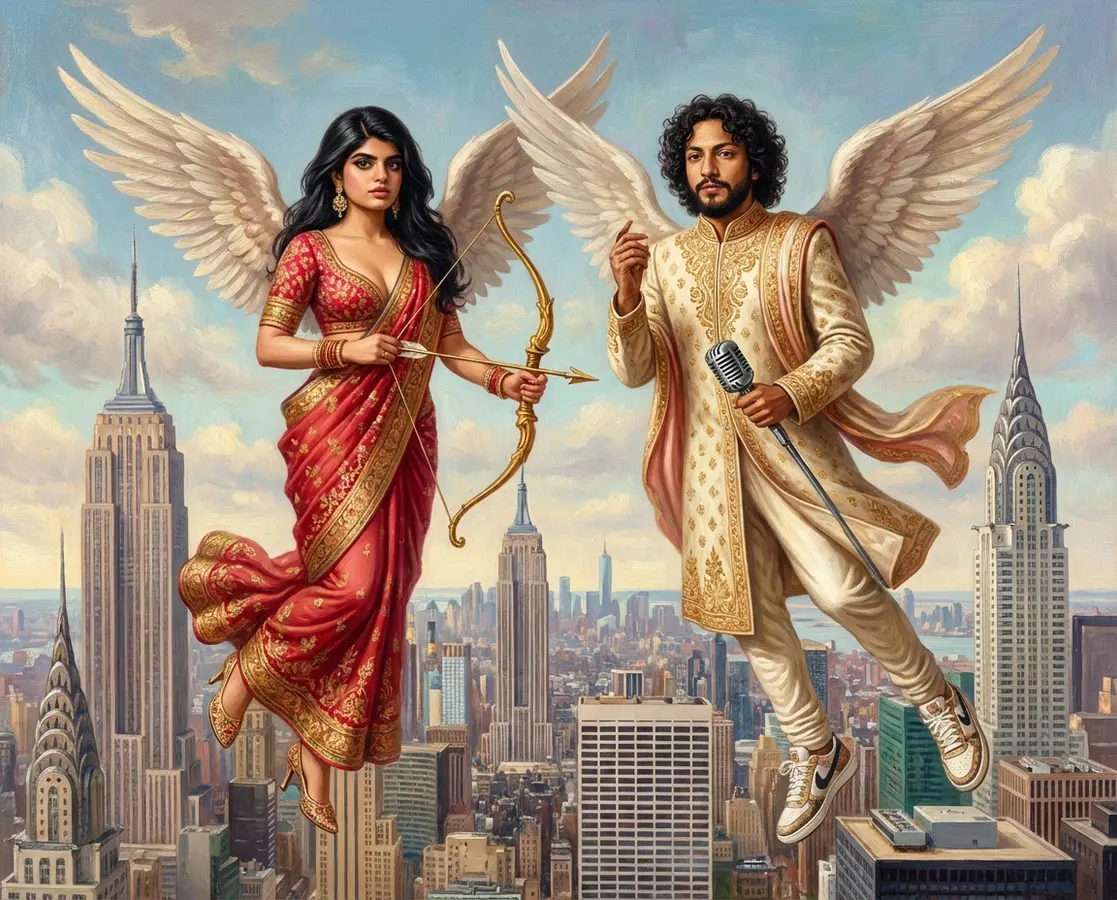
You grew up watching Bollywood love stories and absorbed a very specific curriculum about how romance works. The music swelled, the hero found the heroine against impossible odds, families objected and then relented, and everyone ended up at a wedding. For three decades, that was the South Asian relationship education. No sex ed, no consent conversations, no couples therapy. Just Raj chasing Simran through mustard fields and the vague sense that love was supposed to feel like that.
Here is the thing though. Bollywood got some things right. Not in spite of itself, but genuinely, insightfully right. It also got some things catastrophically, generationally wrong. And the bad parts lived in our brains in a way that took years to unlearn. Let's go through both.
What Bollywood actually understood
The single biggest thing Bollywood got right is that love in South Asian culture is never just between two people. Every classic film understood this at a structural level. The family is a character. The community has a vote. The two people falling in love are navigating an entire ecosystem, not just each other. That is true. That is the actual lived experience of desi romance. You are not just choosing a person. You are choosing a whole constellation of relationships that come with them.
Bollywood understood that the stakes are enormous in a way that Western romantic comedies rarely captured. When you bring someone home in a South Asian family context, you are making a social statement that reverberates through your entire community. The aunties will have opinions. The uncles will compare notes. The grandparents will start planning the wedding before the second date. That social weight is real, and the best Bollywood films rendered it with accuracy.
The films also got the arranged marriage parallel right, even when they were ostensibly love stories. The existence of a parallel track, the family's preferred candidate, the pressure to choose between what you want and what your family has planned, that tension is woven into almost every classic Bollywood romance. And it maps onto real life. Most South Asian singles in 2026 are navigating exactly that tension, even if they'd never describe it as such.
The grand gesture catastrophe
Here is where it went off the rails. Bollywood decided that love is best expressed through the grand gesture. The airport run. The song in the rain. The confession in front of the entire family. The sacrifice that proves devotion. Real love, the films taught us, is recognizable because it is dramatic. If it is not overwhelming you, it is not the real thing.
This taught an entire generation the wrong love language. It taught men that not doing dramatic things means not loving enough, and that doing a dramatic thing, even once, constitutes proof of feeling. It taught women that love should feel like being the center of a film sequence, that being quietly shown up for every day does not count as romance. Both of these are wrong. The grand gesture is a moment. Love is a daily practice. Bollywood sold the moment and pretended that was the whole story.
The research on what actually makes relationships last is boring by Bollywood standards. John Gottman's work on couples shows that the most predictive factor in relationship success is not passion or grand gestures. It is repair attempts. It is whether you can acknowledge when something went wrong and try again. That is deeply unsexy. Nobody is putting a repair attempt to a Rahman soundtrack. But it is what works.
Stalking as romance: the generation-defining mistake
This is the one I find hardest to be diplomatic about. Bollywood systematically romanticized stalking. Darr, Raanjhanaa, Kabir Singh. The villain who loves so hard he becomes dangerous. The hero whose persistence eventually wins the girl. The message was consistent: her no is not an answer, it is an obstacle. Keep going and she will eventually say yes. The love is so pure it justifies everything.
You can measure the damage in real life. I have talked to women who came to Garam Masala Dating to recalibrate what attraction is supposed to feel like, because they had spent years mistaking intensity for love. They had learned from these films that being relentlessly pursued meant being truly desired. They confused anxious attachment with passion. Bollywood gave them that confusion. It runs deep and it takes active work to undo. Read about how Bollywood's toxic heroes shaped real-world red flags if you want to go deeper on this.
The consent vacuum
Closely related: classic Bollywood films contain essentially no model of consent. The heroine does not choose. She is chosen. She is found, pursued, and eventually swept up. Her preferences are not really the point. The narrative mechanics require her to be a prize, not a protagonist. And this got absorbed quietly into the desi dating culture as a baseline. Men who pursue without asking. Women who wait to be pursued. The dance where nobody actually says what they want.
What is genuinely different about where Bollywood films are going now is that the female protagonists have started making actual choices. Shershaah's Dimple is not swept up. She decides. Gehraiyaan's Alisha is not passive. She makes her own bad decisions. Rocky Aur Rani's Rani argues back. The shift toward female protagonists who have genuine interiority and agency is the most important evolution in the genre.
The mythology lives in the desi dating brain
Here is what is insidious about the Bollywood curriculum. You can intellectually reject all of it and still carry it. You can know that the rain confession is not a healthy relationship model and still feel vaguely disappointed when your relationship does not have those peaks. You can know that grand gestures are not the same as love and still feel more loved by a grand gesture than by five years of consistent showing up.
The expectation gap is real. South Asian singles who grew up on Bollywood carry a baseline for what romance is supposed to feel like. Ordinary love, love that is steady and warm and undramatic, can feel like settling. It is not settling. It is the actual thing. But you have to consciously recalibrate your system to recognize it.
I see this at the show. Contestants who are clearly interested in each other but cannot access the feeling because it does not feel like a film. The chemistry is there. The conversation is good. But they are waiting for the swell. The moment. The sign. And sometimes it is not coming because they are in front of real people, not a camera, and real people do not crescendo on cue.
What the current era is doing better
The Bollywood of the last five years is genuinely different. Gehraiyaan (2022) is about an emotional affair that the film does not redeem. Tamasha (2015) is about the cost of performing the acceptable version of yourself. Rocky Aur Rani Kii Prem Kahaani (2023) examines family systems with actual complexity. These films are not perfect. But they are asking different questions than their predecessors. They are asking what love actually looks like when the people involved have interiority.
The evolution is not just in the films. It is in the desi dating conversation. South Asian singles are more willing now to name the mythology they were raised on and examine it. They are reading about attachment theory. They are going to therapy. They are having the conversations about what they actually want that their parents' generation never had. That is genuinely new and genuinely hopeful. The mythology is not gone but it is being interrogated.
The lesson Bollywood never taught
The one thing Bollywood never taught us is that love is a choice you make repeatedly, not a feeling that arrives once and persists on its own. The films end at the wedding. Nothing shows you the decade after. Nobody renders the version where the romance is a thousand small decisions to keep choosing this person. That is the story. That is the love story worth telling.
If you want to see what actual chemistry looks like in real time, stripped of the soundtrack and the choreography, come to a show. Watching two real South Asian singles navigate a first date in front of 250 people will tell you more about what attraction actually is than any Bollywood film ever has. Get tickets here.