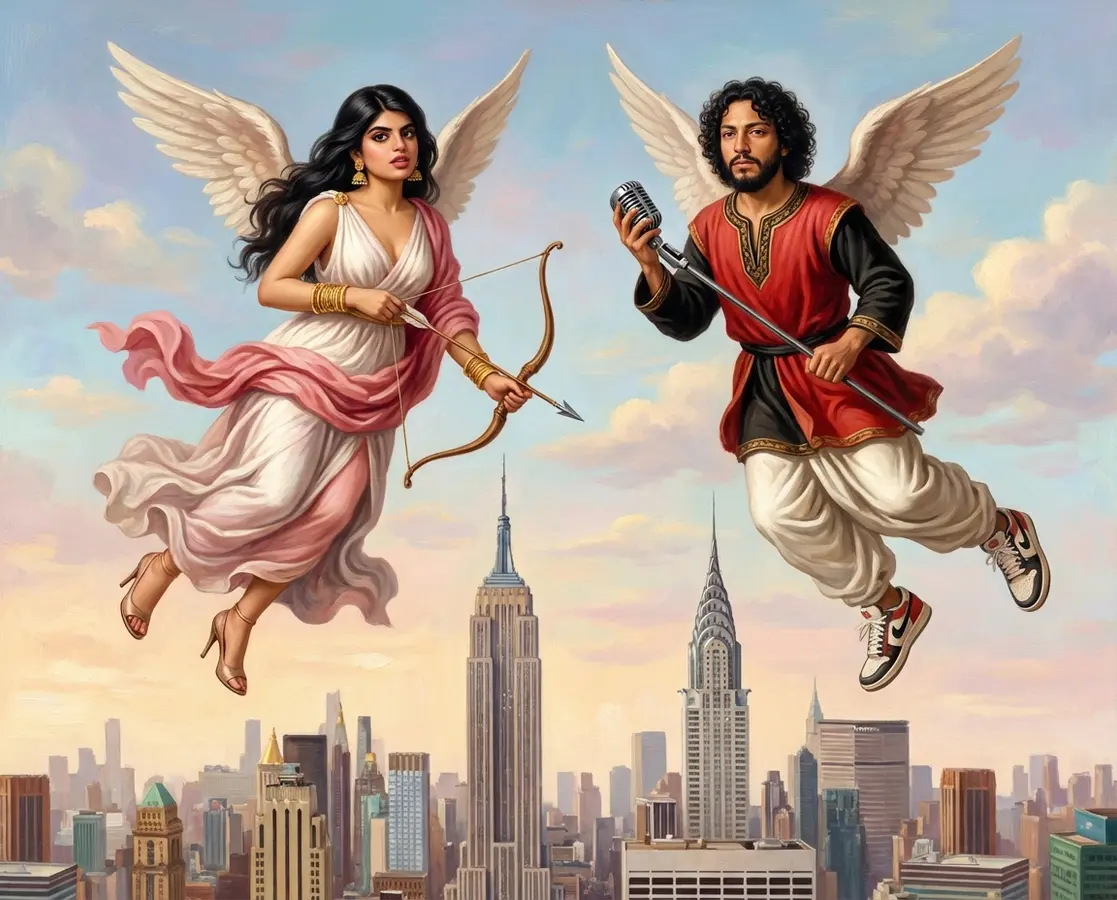
Hindu dating expectations are not a single thing. Hinduism contains multitudes, regional traditions, caste structures, vegetarian and non-vegetarian communities, goddess-worshipping matrilineal traditions alongside strictly patrilineal ones. What they share is that religion doesn't stay outside the relationship. It shapes the timeline, the family involvement, the astrological consultation, and the question of what food will be served at the wedding.
I say this as someone who has grown up adjacent to these expectations and who hosts a show full of Hindu South Asian singles every month. The religious dimension of Hindu dating is often invisible to people outside the community, they see culture, not theology. But for the people living it, the two are inseparable.
Caste: the conversation that never quite goes away
Let's just say it directly: caste is still operating in Hindu South Asian dating, including in diaspora communities in America. The degree varies enormously, from families that explicitly filter by subcaste on matrimonial sites to families that say they don't care and mean it, with everything in between. But the presence of caste as a background variable in Hindu dating is a reality, not a relic.
Matrimonial sites make this visible in the architecture: BharatMatrimony, Shaadi.com, and others allow filtering by caste and subcaste. Millions of people use these filters. That's not because the sites imposed the preference, it's because the preference exists and the sites reflect it. For second-generation Hindu singles who genuinely don't filter by caste in their own choices, the caste question often arrives through their parents rather than themselves.
The most honest thing to say about caste in dating is that claiming 'we don't care about caste' and actually not caring about caste are different things. Families that say they don't care sometimes discover they do care when a real match emerges. Understanding this in advance, having the explicit conversation with your family before you're in the middle of it, is useful even if uncomfortable. The full picture of how caste functions in modern South Asian dating is worth examining directly; the piece on caste in dating in 2026 does that without softening it.
Vegetarianism as religious practice, not dietary preference
In some Hindu communities, particularly Brahmin families across many regions, Gujarati Hindu families, Jain-influenced Hindu households, vegetarianism is not a preference. It's a religious practice connected to ahimsa (non-violence) and purity concepts that have deep roots in Hindu philosophy. A household that is vegetarian by religious conviction is not interested in a partner who will 'eat vegetarian when they're around.' They're looking for a partner who is vegetarian.
This matters enormously for dating compatibility in ways that non-Hindus and even non-vegetarian Hindus often underestimate. For a family where the kitchen is vegetarian for religious reasons, bringing a non-vegetarian partner into that space carries meaning beyond food preference, it touches on ritual purity in ways the family may not even articulate explicitly but feels deeply.
On the other side: Bengali Hindus, Punjabi Hindus, most South Indian Hindus except Brahmins, and coastal Hindu communities are non-vegetarian by tradition. The assumption that 'Hindu equals vegetarian' is wrong and it's useful to not make it. The vegetarianism question is community-specific, and it's worth asking rather than assuming. For a deeper dive into this dynamic, the piece on vegetarian dating as a desi goes into the specifics honestly.
Festival culture as the social infrastructure of Hindu dating
Hindu festivals are the most important social events in Hindu diaspora communities, and they function as dating infrastructure whether anyone names them that or not. Navratri garba nights are the most famous example, thousands of dressed-up Gujarati Hindu singles in the same room, dancing together, family-approved social interaction. The matchmaking function is so well-known that garba nights have become shorthand for 'where Gujarati singles meet.'
But it's not just garba. Diwali parties, community ones, not just the work party with a card, are where extended networks gather and aunties make introductions. Temple events throughout the year create regular community contact. Holi celebrations have a younger, more mixed demographic. Each festival has its own social register and its own matchmaking adjacency.
The festival-as-dating-infrastructure phenomenon is most developed in the Gujarati community, which has built an entire ecosystem around it, something explored in detail in the piece on Gujarati singles events beyond garba. The underlying logic applies across Hindu communities: the social event with family presence and community approval is where introductions feel natural.
Kundali, astrology, and the family checklist
Kundali matching, comparing birth charts to assess compatibility, is alive and well in many Hindu families across South Asian communities. South Indian families, Gujarati families, North Indian traditional families all have varying degrees of reliance on kundali in the marriage process. Some families require it as a first filter before any meeting happens. Others consult it after a match seems promising, as a final check. A small number of families treat it as important cultural ritual even if they don't believe it's predictive.
For second-generation Hindu singles, the kundali question often lands as a moment of cultural negotiation. 'Do you want to know your time of birth?' from a parent is the opening to the conversation. How you handle it reveals what you actually think. Many second-generation singles find it useful to engage with kundali as a cultural practice rather than a literal determinant, it allows for the family ritual without requiring you to decide your partner based on it. This is a pragmatic compromise that lets everyone save face.
Temple matchmaking aunties and the unofficial system
Every Hindu community has at least one matchmaking aunty, and most temples have several. These are not professional matchmakers, they're community members with an expansive social network, strong opinions about compatibility, and an infectious enthusiasm for facilitating introductions. They operate entirely outside any formal system, and they are often remarkably effective.
The temple matchmaking aunty knows your parents. She knows the other family. She can vouch for community standing in ways that a dating app profile cannot replicate. She is also operating with her own set of criteria that may include factors you would prefer she not consider. Engaging with her system means accepting her as a stakeholder in your relationship, which not everyone is willing to do. But dismissing her entirely means opting out of social infrastructure that has real value in tight communities.
Garam Masala Dating is not a temple, and I am not your matchmaking aunty. But we do operate in a South Asian community context that understands why the aunty exists, and we offer an alternative that doesn't require submitting your photos and horoscope to a WhatsApp group. Come to a show. Find upcoming dates on the tickets page.